
10 Best Free Productivity Applications.

We love free software. We especially love free software that helps us get things done faster and better.  Here is our current list of what we feel to be the absolute best free applications.

  1. Google Docs - Google Docs is a suite of products that lets you create different kinds of online documents, work on them in real time with other people, and store your documents and your other files — all online, and all for free. With an Internet connection, you can access your documents and files from any computer, anywhere in the world. https://docs.google.com/#home

  2. WordPress
    Wordpress.com – You can get a blog started in less time than it takes you to read this sentence. All you need is an email address. You’ll get your own WordPress.com address (like you.wordpress.com, you can switch to a custom address later if you’d like), a selection of great free and customizable designs for your blog (we call them themes), 3 gigabytes of file storage (that’s about 2,500 pictures!) and all the other great features listed here. You can blog as much as you want for free, your blog can be public to the world or private for just your friends. http://www.wordpress.com
    WordPress.net – WordPress is web software you can use to create a beautiful website or blog. We like to say that WordPress is both free and priceless at the same time. The core software is built by hundreds of community volunteers, and when you’re ready for more there are thousands of plugins and themes available to transform your site into almost anything you can imagine. Over 60 million people have chosen WordPress to power the place on the web they call “home”. http://www.wordpress.net

  3. Handbreak - HandBrake is a general-purpose, open-source, cross-platform, multithreaded video transcoder software application. HandBrake was originally developed by titer in 2003 as a general-purpose video transcoder to make ripping a film from a DVD to a data storage device easier. Since then, it has undergone many changes and revisions and become widely popular amongst film enthusiasts. http://handbrake.fr/details.php

  4. Join.me - Instant screen sharing and web conferencing. Get everybody on the same page, when they’re not in the same room, instantly. Review documents and designs. Train staff. Demo products or just show off. join.me is a simple screen sharing tool for meetings on the fly. 250 viewers, share control, multi-monitor, chat, send files, share multiple monitors, chat and send files. - https://join.me/
  5. Free Video Email – If a Picture’s Worth a Thousand Words… Then a Video is Priceless! One thing’s for sure … it’s worth more than just plain text. And now, WowWe offers you the opportunity to use cutting-edge video email for FREE! You can bring your email communications to life what you communicate in a video is miles past what can be said with the written word. Put simply, a Free vMail account allows you to pack more into what you’re communicating. You can use your vMail account for personal and family communications, or even to promote a business. Any computer with Internet access and a web cam can now become a powerful video communication tool targeting just the right message to just the right people. So get started today… after all, it’s totally free! http://mediamediainc.iwowwe.com/free-video-email.html
  6. Audacity is a free, easy-to-use and multilingual audio editor and recorder for Windows, Mac OS X, GNU/Linux and other operating systems. You can use Audacity to: Record live audio, Convert tapes and records into digital recordings or CDs, Edit Ogg Vorbis, MP3, WAV or AIFF sound files, Cut, copy, splice or mix sounds together, Change the speed or pitch of a recording and more! http://audacity.sourceforge.net/

  7. Jing - Share Ideas Instantly. Simple and FREE, Jing is the perfect way to enhance your fast-paced online conversations. Create images and videos of what you see on your computer screen, then share them instantly! For Business: Add notated screenshots to all your online conversations, or create a quick tutorial video you can share with the entire company. Get everyone on the same page with Jing. For Education: Give your students the information they need, when they need it. Use Jing to record your feedback as you grade papers, or take a snapshot to share with your class. Your students can even use it to collaborate, or ask questions! http://www.techsmith.com/jing.htm

  8. Dropbox. Dropbox is a free service that lets you bring your photos, docs, and videos anywhere and share them easily. Dropbox was founded in 2007 by Drew Houston and Arash Ferdowsi, two MIT students tired of emailing files to themselves to work from more than one computer. Today, more than 45 million people across every continent use Dropbox to always have their stuff at hand, share with family and friends, and work on team projects. Always have your stuff when you need it with @Dropbox. 2GB account is free! http://db.tt/08DW4lp
  9. Evernote. Evernote makes it easy to remember things big and small from your everyday life using your computer, phone, tablet and the web. With Evernote, all of your notes, web clips, files and images are made available on every device and computer you use. Remember things you like. Save everything cool and exciting you see online and in the real world. Snap a photo, record some audio and save it. Save entire webpages to your Evernote account with our nifty browser extensions. You get the whole page: text, images and links. Take notes anywhere You’re always moving, your notes should be too. With Evernote, your memories are on every computer, phone and device you use. http://www.evernote.com
  10. Prezi - Prezi is a cloud-based presentation software that opens up a new world between whiteboards and slides. The zoomable canvas makes it fun to explore ideas and the connections between them. The result: visually captivating presentations that lead your audience down a path of discovery. http://prezi.com/

Looking for a Job? Reinvent yourself.

The economy sucks. People are struggling with making ends meet, interest rates are high, banks are starting to charge additional fees on ATM cards, groceries are more expensive than other. Even things like peanut butter, a staple in every household, will be going up 20-25% in t he next few months.

Things will get better, they always do. Unfortunately that doesn’t help you pay the bills now. We really don’t know if it will take a year or a decade for the economy to improve.

The good news is,  the best thing you have going for you is your ability to adapt.

You have 100% control to rethink the way that you work, the way that you communicate and the way that you take personal responsibility for reinventing yourself.

Need more money? Then take the time to understand the value in you.

Here is the way that it works…The major thing that businesses and employers think about is profits.

Sure, there are great employers out there who are concerned about working conditions, being able to pay or help with benefits and the needs of their employees, but strip away their profits and no matter how wonderful they are, they will focus on getting rid of those employees who do not understand the importance of building company profitability. I can teach you how to get inside the head of your employer and to understand how they think.

I wrote the book 1000 Resumes, One Job with one thing in mind….getting people to rethink the way that they thought about getting a job. This book will teach you how to get noticed, things that you can do differently and better ways to communicate.

There are two ways that you can get this book. You can buy it from Amazon for $14.95, or you can read it for free on-line. My gift to you.

Click here to learn more and to read the book for free.

E-JUNKIE – robust shopping cart for eCommerce

E-junkie - We help you sell online

E-junkie provides shopping cart and buy now buttons to let you sell downloads and tangible goods on your website,eBayMySpaceGoogle BaseCraigsList and other websites using PayPal Website Payments Standard, PayPal Website Payments Pro, PayPal Payflow Pro, Google Checkout,Authorize.Net, TrialPay, ClickBank and 2CheckOut.

For merchants selling downloads, they automate and secure the digital delivery of files and codes. If you are selling tangible goods, they automate the shipping calculation and inventory management. Our shopping cart has a built in sales tax, VAT, packaging and shipping cost calculator.

You can sell ebooks, sell mp3 tracks and albums, sell software, icons, fonts, artwork, phone cards, event tickets, cds, posters, books, t-shirts and almost everything else you want to sell.

E-junkie has no transaction limit, no bandwidth limit, no setup fee and no transaction fee.

E-junkie Shopping Cart and Digital Delivery

You and the 80-20 rule

I’m a college drop-out.

I decided to enter the work-force at 18 instead of spending another four to eight years in school. During the years between 18 and 30, I enrolled at Merritt College in Oakland, Vista College and Open Education Exchange in Berkeley…took classes and promptly dropped out.

Most of you have more education than I do. My lack of education hasn’t stopped me. I was an Art Director when I was 18, a General Manager for a group of Newspapers at 25, Sales Manager, Director of Sales and VP of sales for Kinko’s, Director of Sales and Marketing for a couple high-tech companies in California and then ultimately decided that I would rather work for myself.

The real difference is having the three As…Attitude, Aptitude and Appetite.  Attitude is demonstrating a positive frame of mind with good presence and a high, yet realistic confidence level. Aptitude is more than formal education, it’s the capacity and desire for learning. Appetite is the pure desire to succeed and the willingness to do whatever it takes to accomplish it.

The secret of standing out is to recognize and understand that the most important thing for a business is profitability.

Without this, no matter how noble a business is, that business will be short lived. When you and 1000 other people apply for the same position, the people who don’t know this will be quickly dismissed from the pool of candidates.

Think about how valuable you would be to a prospective employer if you framed all of your job history and transferable skills to their generating profits. If, while you were communicating with them, you could frame all of your abilities and skills in a way that they knew you wouldn’t need much training, you could do things faster, better or smarter than the rest of the candidates who were applying. If you truly believed in your abilities and could learn to do this, you’d probably get hired when there wasn’t a formal job opening. This is what I have always done…and then, when I decided to work for myself, I created a business.

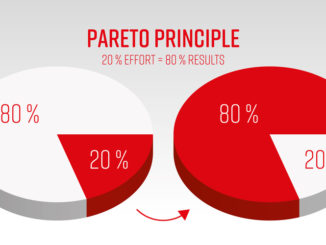
The Pareto principle, also known at the 80-20 rule, the vital few and the principle of factor sparsity states that 80% of the effects come from 20% of the causes.

Business management thinker Joseph Juran suggested this principle and named it after Italian economist Vilfredo Pareto who observed in 1906 that 80% of the land was owned by 20% of the population.

He further developed the principle by observing that 20% of the pea pods in his garden contained 80% of the peas. Business people have taken this a few steps further and acknowledge that 20% of the customers bring in 80% of the revenue, 20% of a sales team bring in 80% of the business. In manufacturing, 80% of your inventory will come from 20% of your suppliers, 20% of your inventory takes up 80% of the space, 20% of the staff will create 80% of the problems, There have been studies that 20% of the population use 80% of health care resources, 80% of the crimes are committed by 20% of the criminals, etc.

Depending on what you are looking at and how you are categorizing it, you can use the Pareto principle to identify both the critically good and the critically bad.

Over the last few years, businesses have laid off a lot of people. The truth is, they laid off the bottom 20-50% of their staff. Since it became “okay” for businesses to let everyone know that they were downsizing, right-sizing or reorganizing, this was a perfect opportunity to get rid of the people who were not performing.

The majority of business managers, owners and executives have been exposed to this rule at some point in their career and they believe it. It’s up to you to prove to them during your entire term of employment that you are in the smaller percentage of employees who contribute to the larger percentage of results.

Everything you do, your approach, your resume, your conversations, your manner of speech and the way you dress for the interview has to be top-notch. You have to demonstrate that you are the best candidate.

In your job search, you want to be one of the amazingly great…the vital few. You want to demonstrate that you are one of the 20% of their organization who will achieve 80% of results.

Portions of this are from my upcoming book, 1000 resumes, One Job (an employer’s perspective). Although this book is written to help people to take personal inventory, reinvent and reposition themselves during a job search, it can easily be adapted for all business situations.

Indie Artists Alliance Guide to College Radio

Need to get Radio Spins?

Indie Artists Alliance, a division of Media Media Inc.  has come up with the best and most affordable resource guide in America for getting college radio airplay for only $9.95

It’s a fact! Without the backing of a major record label, most Indie artists will never get airplay on mainstream radio. Why? Because in the big business of music, cash (for promotion) is king and struggling performers usually don’t have much.

However, that doesn’t mean there are no other exposure opportunities out there. One avenue for Indie artists to get their tunes spun on the airwaves is college radio.

There are hundreds of these stations in the United States looking for quality music to broadcast — in all genres. That doesn’t mean they will play everything that lands on their desk, but as a rule, college radio stations are open to giving new songs a chance if they believe they will appeal to their audience.

This guide not only lists most all stations, but also includes detailed and up-to-date contact information, as well as inside information about how to submit material.

“Radio play means  more CD, digital media sales and gigs,” says Phil Peretz of Indie Artists Alliance, “We are driven to create new and unique ways for Indie Artists to succeed as our growing suite of products and services and are proud to announce the release of this guide.”

Along with submission tips,  every state-by-state listing in the guide includes the genre’s of each station, as well  as their address, main phone number, studio phone number, email address and contact person.

It also states what type of formats they prefer songs to be submitted in, such as CD’s, CD-Rs or mp3s.

If all that weren’t the bargain of the century, “Indie Artists’ Greatest Guide To Getting College Radio Play” also features in-depth articles and expert tips on writing an effective press release, constructing a compelling cover letter and guaranteed ways to attract a DJ or music director’s attention.

Contributors for the E-book include Peretz and Luanne Hunt, an entertainment journalist and public relations specialist, who has interviewed hundreds of music, television and sports personalities, including Ray Charles, Jon Bon Jovi, Loretta Lynn, Toby Keith, Wynonna Judd, Trisha Yearwood, Randy Travis, Jewel, and Jessica Simpson. Peretz is founder and President of Media Media, Inc. and Indie Artists Alliance.

This ebook is jam packed with verified contact listings, all information that you need to get spins from College Radio Stations for all most genres of music, Hip Hop, Americana, Rock, Alternative, Country, Metal, etc.

We are also including coaching articles by Luanne Hunt and Phil Peretz  on how to put your best foot forward to insure the highest degree of success.

To order: http://www.indieartistsalliance.com/guide-to-college-radio-airplay/

Indie Artists Alliance is a division of Media Media Inc. in Reno Nevada

…just click it…

I was just on a website that a friend runs called Burncards http://www.burncards.com and it all became perfectly clear.

I like this guy, in fact, I like him a lot. He’s a smart guy and has some interesting things to say. He’s not the only one though, There are a number of blogs that I regularly read and I run a few sites myself where I spend a great deal of time writing articles, sell a few of my own products and services and then, I have those Google ads on my site.

For most people, running an informational website or a blog is a passion about a particular subject or locale. One of my sites is a community events and calendar site for Reno/Sparks area called Reno Datebook (www.renodatebook.com). I spend countless hours every week making sure that it’s interesting, up to date and a useful resource. I give away ads to businesses in the community and have some Google ads on the site.

In case you missed this, let me do it again…

I spend hours and hours writing articles and finding press releases (I don’t get paid for this…it’s because I love my community)

I give away ads to businesses in the community in the hopes that this will bring them business or push traffic to their websites. (Give away, as in, I don’t get paid for this…I do it because I love my community)

I run some Google ads and unless people click on them, I don’t get paid. Just like the majority of bloggers out there, it’s fun and it’s a passion, but what if people came to these sites and before they left, they checked out some of the advertisers? What if they clicked on the Google ads to see what the advertisers were selling?

They way it works is pretty simple. The blogger sets up an account with Google or another similar site. Google sells advertising to companies that get their ads placed contextually. This means that if you are looking at my Reno Datebook site, you’ll see ads that, for the most part, make sense based on the subject material on the page.

There is more to it than this, but that’s the snapshot of how it works. Google agrees to pay bloggers on a pay for click basis in hopes that people will find something of interest and will click on the ad and visit their website and purchase from them.

When you click on the ad, the blogger get paid….not a lot, but enough to make it a little profitable and more fun to do. If a lot of people click on the ads, they get paid more and it becomes a lot more fun.

Then, to make it fair to the advertisers, odds are, a percentage of people who click on the ads will purchase from the advertisers and will buy from them.

Everybody wins….you, the reader, get cool content. The person running the blog gets paid and the Advertisers get customers.

Bottom line…click away, and support your local blogger.

Compelling your Clients

I started in advertising right out of school as an art director for a group of Shopper Newspapers in California. I had a wonderful boss who regularly and gently beat me up with his chant of “Who, What, Where, When and Why.”

I’d get the ad copy from the salespeople and I would put together a series of speculative ads for them to go out and sell new clients. This was in the early 70’s. This was when salespeople didn’t need to be called Account Executives or Marketing Managers. They knew who they were…they were salesmen and saleswomen.

Their job was to make things happen…help get people in the door so they would buy something. The idea of speculative ads was to get the prospective advertisers excited about doing business with us and to know that we cared and understood their business. We made sure that these ads contained a who (the store), what (the item or service being sold), where (the complete address and contact information including the City and State), When (the date or range of dates including  the year) and Why (the compelling reason for doing business NOW!). 

If everybody realized that their job was that of a salesperson, business would be better. If nothing else, business would be easier. Selling is sharing complete information to make sure that people are able to make an informed decision to do business with you.

The mantra of who, what, where, when and why is more important today then it was in the 70’s. In the 70’s advertising was disposable. Magazines and newspapers were time dated and radio and TV ads were always ‘in the now’…or the next weekend. You would never expect to pick up a newspaper 6 months later and expect the specials in the newspaper ads to still be going on.

Now, in the internet age, nothing goes away, ever.

There are massive amounts of legacy material on the internet. People are searching for events and bargains and without complete information, they can’t make an informed decision. So, more often than not, they do nothing. They don’t come to your event, they don’t call you and they don’t spend their money with you.

Nothing is more frustrating than to find an event on Facebook, on a website or blog that is incomplete. Since information doesn’t go away, the simple addition of the year to a post will let people know if the information is current, if it happened last year or years before. Little things like the City and State in a post will help people know if the event is local or across the country. Detailed descriptions of what the events is about and how it interests or affects them will engage people and compel them to get involved.

The more information you give your readers, the more likely they will want to be involved with your business or event. If your ad, invitation or post answers Who, What, When, Where and Why, you’ve helped your reader, you’ve given them compelling reasons to do business with you and more than likely, you’ll see an upturn in business.

Barcodes for Beginners


You decide to go into business manufacturing, importing or wholesaling products.

You’ve manufactured or ordered products and you realize that you need a barcode to sell in stores.

You come to Nationwide Barcode and you order one barcode for each product that you have. (Colors and sizes are considered different products) – Media Media Inc. is the sister company to Nationwide Barcode…you can purchase on this site, too.

Nationwide Barcode e-mails your barcodes lightening fast…plus our eBook ‘Barcodes DeMystified’, phone or e-mail support, resources for label printing and 15% off on all of your business printing needs. (Wow!)

You either include the barcode graphic as part of your packaging design or (if it’s already done) get barcode labels. We’ll get you great prices from our friends at Pacific Barcode. They are fast, too.

Congratulations…you are now ready for business and can start selling your products to stores (If you are planning on selling to Walmart or Kroger’s, they are going to require that you spend the big money and get your own prefix directly from  the GS1. Most other stores are perfectly fine with barcodes from Nationwide Barcode.  We have sold clients selling to Amazon, Lowes, Staples, Whole Foods, Trader Joes, Office Max and Target)

You are ready to wholesale your products to stores…you knock on doors, make phone calls and convince them that you have something that their customers want. They agree!

You supply the stores with a list of your products, product details and the UPC/EAN number for each item. There is nothing embedded in a UPC or EAN barcode except for the numbers that are beneath the barcode. When they enter the info into their database, the numbers are associated with your product. When a barcode scanner scans the barcode, it turns the bars back into numbers and looks for the item associated with it.

The information that you have supplied gets entered into the computer that connects all of their POS systems (electronic cash registers). All of this is done at store level because there is no accurate and complete database of products, and if there was, it could potentially carry 10,000,000,000 items. That’s too much data for local stores to access, so, all stores only concern themselves with their inventory.

Your products are delivered to the retailer and once received into inventory and are now available for purchase.

A customer picks up the item and heads to the checkstand.

The item is scanned and the point of sale system (cash register) requests information about  the product from the database. Once purchased, the Point of Sales system tells the database to subtract the number of items purchased.

The customer pays for the item and the transaction is complete.

The Retail Buyer’s Checklist

You have spent a lot of time and money developing your new  business and now, you plan on making phone calls or knocking on the doors of the retailers in your area.

The job of a retail buyer is to make informed decisions whether or not to buy your product. They have to do this because they report to senior management who will ask them all these same questions before signing the Purchase Order and approving the purchase. Here is a list of questions that many buyers will ask prior to adding your new product to their inventory.

  • Who is your target audience? How do you know this?
  • Do you own patents to this product? Can it be knocked off by a competitor?
  • If I place an order, do you have it in stock or is there a lead time before you can ship?
  • What are the minimum order requirements?
  • Who pays freight from your warehouse? Is there a certain oredr qualtity where you will pay freight?
  • Do you have competition? Who is it?
  • What is my cost on the product?
  • What is the retail selling price?
  • How did you determine this price?
  • Do you think this is a competitive price?
  • Who else is selling this product?
  • How did you test and certify this product? (electrical products need UL)
  • How do we deal with defectives?
  • What is the warranty?
  • What is the average defective rate for this item?
  • How is the product boxed and shipped to the retailer?
  • How is your item packed to sell? Box, bag, clam shell, etc.
  • Do you have a UPC/EAN barcode for your product?
  • Do you have product samples available for testing?
  • Do you have marketing funds for us to help sell your products?
  • Is their training for the retail sales associates? How is this training delivered?

Remember, although your item may be a passion for you, it is a business for the retailer and is one of thousands and thousands of items in their shop. They want to feel confident about your product

As business consultants, we can help you with your business. Feel free to book an appointment for consultation at www.mediamediainc.com

15,000 Private Label Articles for $9.99

“Who Else Wants To Grab The No Restriction Private Label Rights To 15000 Top-Shelf Articles That You Can Instantly Turn Around and Sell?”

Content, Content, Everyone Screams CONTENT!  Here’s Your Chance To Provide The Content Needs To Thousands Of Webmasters While You Rake In The Profits!

Are you looking for way to potentially make hundreds of thousands of dollars on the internet without having to work hard? Private Label Rights are the most desired investment that you can make online right now. Private Label Rights, or PLR, consists of content that is written and sold for you to do whatever you want. You can purchase PLR from writers and sell it to businesses for a considerable profit without having to quit your day job.

Continue reading

Switch to our mobile site